Gluteal region
Model
Layers
Z-Anatomy anatomical model based on BodyParts3D, licensed CC BY-SA 4.0.
Overview
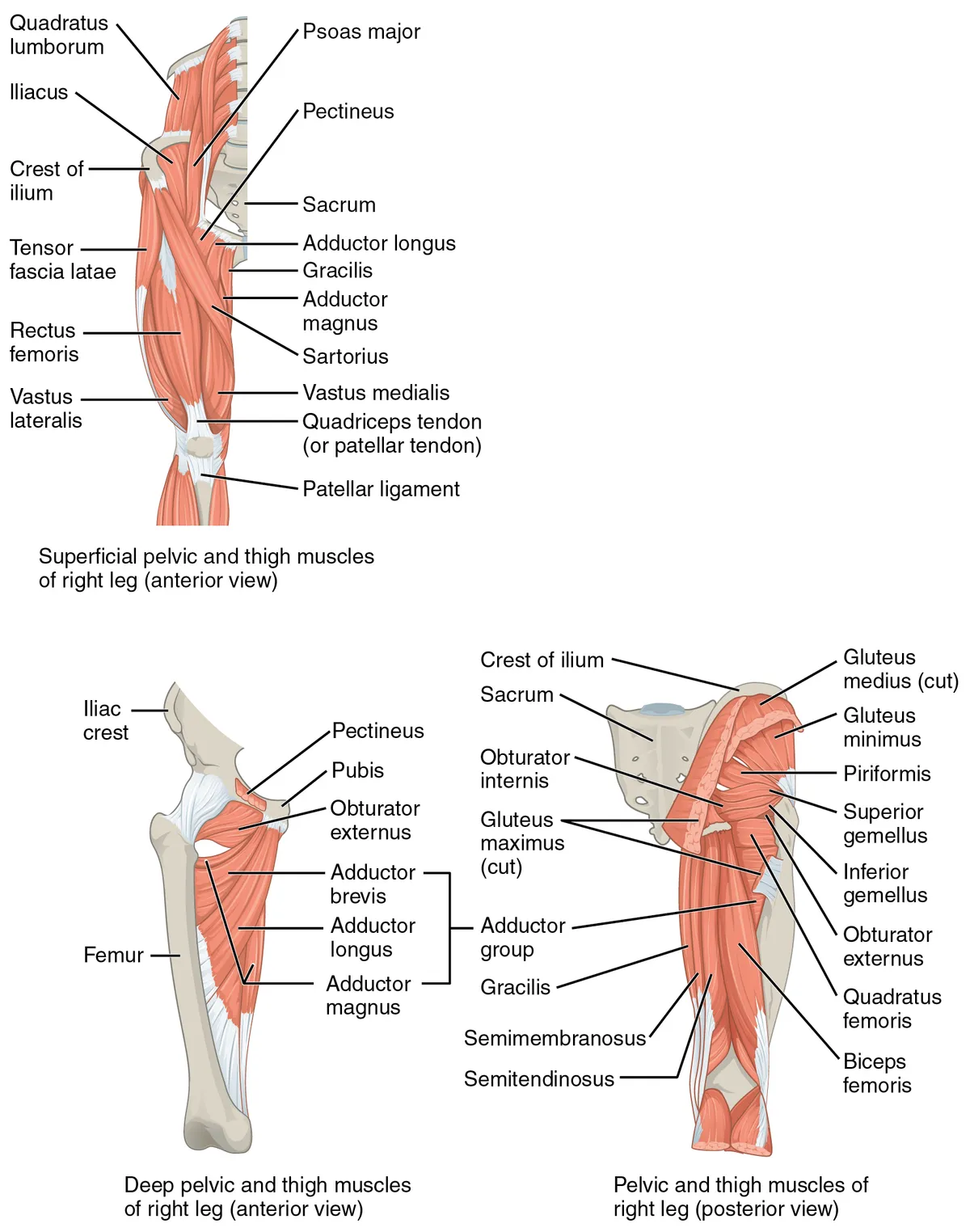
A regional model of the (right) gluteal region: the hip bone, sacrum and upper femur, the hip joint and the sacrospinous and sacrotuberous ligaments that bound the greater and lesser sciatic foramina, the three gluteal muscles, piriformis and the short lateral rotators (gemelli, obturator internus, quadratus femoris), the bursae, the superior and inferior gluteal neurovascular bundles, the sciatic nerve and the pudendal nerve and internal pudendal vessels.
Boundaries and subdivisions
The gluteal region lies behind the pelvis, from the iliac crest down to the gluteal fold, medially bounded by the sacrum and coccyx and laterally by the greater trochanter of the femur. The sacrospinous ligament (sacrum to ischial spine) and sacrotuberous ligament (sacrum to ischial tuberosity) convert the greater and lesser sciatic notches into the greater and lesser sciatic foramina. The greater sciatic foramen is the main gateway from the pelvis to the buttock and is divided by piriformis into suprapiriform and infrapiriform openings. For safe intramuscular injection the buttock is divided into quadrants and the injection given in the upper outer quadrant, away from the sciatic nerve.[1]
Layers from superficial to deep
Under thick skin and fat lies gluteus maximus, the largest and most superficial muscle, which extends and laterally rotates the thigh and inserts into the iliotibial tract and gluteal tuberosity. Deeper, gluteus medius and minimus insert on the greater trochanter and keep the pelvis level when standing on one leg. Beneath them are the short lateral rotators of the hip, from above down: piriformis, superior gemellus, obturator internus, inferior gemellus and quadratus femoris (obturator externus lies deeper). Several bursae separate the muscles, such as the trochanteric bursa of gluteus maximus and the ischial bursa.[1][2][3][4]
Vessels, nerves and lymphatics
The superior gluteal nerve and vessels pass above piriformis (supplying gluteus medius, minimus and tensor fasciae latae). Below piriformis pass the inferior gluteal nerve and vessels, the sciatic nerve, the posterior femoral cutaneous nerve, the nerves to obturator internus and quadratus femoris, and the pudendal neurovascular bundle. The inferior gluteal nerve (L5–S2) supplies a single muscle, gluteus maximus. The inferior gluteal artery accompanies the sciatic nerve; both gluteal arteries are branches of the internal iliac artery.[1][2][5]
Embryology
The lower limb bud forms at about week 4 (embryonic stage 14) as a mass of mesenchyme covered by ectoderm on the ventrolateral wall, through reciprocal induction between ectoderm and mesoderm. By stage 17 the limb has a flattened footplate and a recognisable hip joint but no proper knee; the digits separate during stages 20–23 and are distinct by the end of week 8. As the bud grows it receives nerves from the last four lumbar and first three sacral segments, which is why the gluteal muscles and piriformis are supplied by branches of the sacral plexus (L4–S3). Like other skeletal muscles, gluteus medius and piriformis are formed from somite-derived cells that migrate into the limb bud.[4][3]
Anatomical variants
Piriformis varies in its nerve supply (S2 alone in some people, L5–S2 in others) and in its structure; in at least a fifth of the population the sciatic nerve or its common fibular part pierces the muscle at different points, and in some individuals the muscle’s borders are poorly defined. The superior branch of the superior gluteal nerve may run below the inferior branch before entering tensor fasciae latae, but the more frequent variation concerns its distribution around the greater trochanter, which matters for lateral hip incisions.[3][5][6]
Clinical correlations
A misplaced intramuscular injection can injure the inferior gluteal or sciatic nerve and cause a pseudoaneurysm of the inferior gluteal artery. Superior gluteal nerve palsy weakens gluteus medius and minimus: when standing on the affected leg the pelvis drops on the opposite side (Trendelenburg sign). The sciatic nerve can be compressed by piriformis (piriformis syndrome) or injured in posterior hip dislocation. Rupture of the inferior gluteal artery can cause gluteal compartment syndrome and sciatic nerve palsy.[1]
Surgical and procedural considerations
Gluteus medius and its artery and nerve can be damaged by hip fracture, dislocation and arthroplasty; the direct lateral approach splits gluteus medius to reach the joint and therefore carries the highest risk of nerve injury, because the superior gluteal nerve runs only a few centimetres above the greater trochanter. Percutaneous iliosacral screws used to fix the pelvic ring can also injure the nerve. A misplaced intramuscular injection in the buttock can injure the superior gluteal or sciatic nerve, which is why injections go into the upper outer quadrant. Piriformis syndrome, an irritation of the proximal sciatic nerve with hip and buttock pain, is often misdiagnosed and mistreated; surgical release of the piriformis tendon from the greater trochanter is reserved for cases refractory to all non-operative measures.[4][5][3]
Key structures
Foramen ischiadicum majus
- Name
- Greater sciatic foramen
- Position, role
- Pelvis-to-buttock gateway; divided by piriformis
Foramen ischiadicum minus
- Name
- Lesser sciatic foramen
- Position, role
- Obturator internus tendon; pudendal bundle into the perineum
M. gluteus maximus
- Name
- Gluteus maximus
- Position, role
- Extends and laterally rotates the thigh; inferior gluteal nerve
M. gluteus medius
- Name
- Gluteus medius
- Position, role
- Abducts the thigh, levels the pelvis; superior gluteal nerve
M. piriformis
- Name
- Piriformis
- Position, role
- Key landmark of the region; lateral rotator
N. ischiadicus
- Name
- Sciatic nerve
- Position, role
- L4–S3; leaves below piriformis into the back of the thigh
Lig. sacrotuberale
- Name
- Sacrotuberous ligament
- Position, role
- Bounds the lesser sciatic foramen; gives origin to gluteus maximus
| Terminologia Anatomica | Name | Position, role |
|---|---|---|
| Foramen ischiadicum majus | Greater sciatic foramen | Pelvis-to-buttock gateway; divided by piriformis |
| Foramen ischiadicum minus | Lesser sciatic foramen | Obturator internus tendon; pudendal bundle into the perineum |
| M. gluteus maximus | Gluteus maximus | Extends and laterally rotates the thigh; inferior gluteal nerve |
| M. gluteus medius | Gluteus medius | Abducts the thigh, levels the pelvis; superior gluteal nerve |
| M. piriformis | Piriformis | Key landmark of the region; lateral rotator |
| N. ischiadicus | Sciatic nerve | L4–S3; leaves below piriformis into the back of the thigh |
| Lig. sacrotuberale | Sacrotuberous ligament | Bounds the lesser sciatic foramen; gives origin to gluteus maximus |
What each layer contains
SkinCutis5
- Hip region
- Gluteal region
- Lumbar region
- Sacral region
- Gluteal fold
Muscles, fasciae and tendon sheathsMusculi, fasciae et vaginae tendinum45
- Tendinous arch of levator ani
- Sciatic bursa of gluteus maximus muscle
- Sciatic bursa of obturator internus
- Bursa of piriformis muscle
- Subcutaneous trochanteric bursa
- Subtendinous bursa of iliacus muscle
- Subtendinous bursa of obturator internus
- Superior bursa of biceps femoris muscle
- Trochanteric bursa of gluteus maximus muscle
- Trochanteric bursa of gluteus minimus muscle
- Intermuscular gluteal bursae
- Long head of biceps femoris
- Piriformis fascia
- Anterior layer of thoracolumbar fascia
- Middle layer of thoracolumbar fascia
- Posterior layer of thoracolumbar fascia
- Interspinales lumborum muscles
- Coccygeus muscle
- Inferior gemellus muscle
- Superior gemellus muscle
- Gluteus maximus muscle
- Gluteus medius muscle
- Gluteus minimus muscle
- Gracilis muscle
- Iliacus muscle
- Iliococcygeus muscle
- Iliocostalis lumborum muscle
- Latissimus dorsi muscle
- Multifidus lumborum muscle
- External abdominal oblique muscle
- Internal abdominal oblique muscle
- Piriformis muscle
- Pubo-analis muscle
- Pubococcygeus muscle
- Quadratus femoris muscle
- Quadratus lumborum muscle
- Semitendinosus muscle
- Transversus abdominis muscle
- Obturator externus
- Obturator internus
- Dorsal parts of lateral intertransversarii lumborum muscles
- Ventral parts of lateral intertransversarii lumborum muscles
- Psoas major
- External anal sphincter
- Trochanteric bursa of gluteus medius muscle
Bones and cartilageOssa et cartilagines8
- Coccyx
- Hip bone
- Femur
- Sacrum
- Vertebra L2
- Vertebra L3
- Vertebra L4
- Vertebra L5
Joints and ligamentsJuncturae et ligamenta27
- Articular capsule of hip joint
- Triradiate cartilage
- Intervertebral disc L2-L3
- Intervertebral disc L3-L4
- Intervertebral disc L4-L5
- Intervertebral disc L5-S1
- Frenula capsulae
- Acetabular labrum
- Ligament of head of femur
- Iliolumbar ligament
- Intercornual ligament
- Ischiofemoral ligament
- Pubofemoral ligament
- Anterior sacro-iliac ligament
- Interosseous sacro-iliac ligament
- Posterior sacro-iliac ligament
- Sacrospinous ligament
- Sacrotuberous ligament
- Transverse acetabular ligament
- Obturator membrane
- Nucleus pulposus L2-L3
- Nucleus pulposus L3-L4
- Nucleus pulposus L4-L5
- Nucleus pulposus L5-S1
- Descending part of iliofemoral ligament
- Sacrococcygeal symphysis
- Zona orbicularis
ArteriesArteriae16
- Superior anorectal artery
- Lateral circumflex femoral artery
- Medial circumflex femoral artery
- Inferior gluteal artery
- Superior gluteal artery
- Internal iliac artery
- Iliolumbar artery
- Obturator artery
- Internal pudendal artery
- Median sacral artery
- Lumbar arteries
- Anterior division of internal iliac artery
- Posterior division of internal iliac artery
- Iliacus branch of iliolumbar artery
- Lumbar branch of iliolumbar artery
- Spinal branch of iliolumbar artery
VeinsVenae9
- Basilic vein
- Internal iliac vein
- Iliolumbar vein
- Internal pudendal vein
- Lateral circumflex femoral veins
- Inferior gluteal veins
- Superior gluteal veins
- Lumbar veins
- Lateral sacral veins
NervesNervi15
- Cauda equina
- Intercostal nerves
- Lateral femoral cutaneous nerve
- Posterior femoral cutaneous nerve
- Genitofemoral nerve
- Superior gluteal nerve
- Iliohypogastric nerve
- Ilio-inguinal nerve
- Sciatic nerve
- Nerve to piriformis muscle
- Nerve to quadratus femoris muscle
- Obturator nerve
- Pudendal nerve
- Anterior root of posterior femoral cutaneous nerve
- Posterior root of posterior femoral cutaneous nerve
LymphaticsSystema lymphoideum9
- Inferior gluteal nodes
- Superior gluteal nodes
- Obturator nodes
- Pararectal nodes
- Postvesical nodes
- Retrocaecal nodes
- Lateral sacral nodes
- Median sacral nodes
- Lateral vesical nodes
Full-text reading (StatPearls)
The StatPearls chapters on this topic, reproduced verbatim. Their CC BY-NC-ND 4.0 licence allows unmodified copies only, so they are not translated or shortened.
Anatomy, Abdomen and Pelvis: Superior Gluteal NerveLung K, Lui F · StatPearls 2023 · NBK535408 · 13k characters
Loading…
Lung K, Lui F. Anatomy, Abdomen and Pelvis: Superior Gluteal Nerve. StatPearls [Internet]. Treasure Island (FL): StatPearls Publishing; 2023. NBK535408 · PMID 30571029 · CC BY-NC-ND 4.0. Reproduced verbatim, unmodified.
Anatomy, Bony Pelvis and Lower Limb, Gluteus Medius MuscleShah A, Bordoni B · StatPearls 2023 · NBK557509 · 12k characters
Loading…
Shah A, Bordoni B. Anatomy, Bony Pelvis and Lower Limb, Gluteus Medius Muscle. StatPearls [Internet]. Treasure Island (FL): StatPearls Publishing; 2023. NBK557509 · PMID 32491441 · CC BY-NC-ND 4.0. Reproduced verbatim, unmodified.
Anatomy, Bony Pelvis and Lower Limb: Piriformis MuscleChang C, Jeno SH, Varacallo MA · StatPearls 2023 · NBK519497 · 8k characters
Loading…
Chang C, Jeno SH, Varacallo MA. Anatomy, Bony Pelvis and Lower Limb: Piriformis Muscle. StatPearls [Internet]. Treasure Island (FL): StatPearls Publishing; 2023. NBK519497 · PMID 30137781 · CC BY-NC-ND 4.0. Reproduced verbatim, unmodified.
Regional anatomy
References
Sources for the values and descriptions on this page, indexed in PubMed (US National Library of Medicine).
- [1]Anatomy, Bony Pelvis and Lower Limb, Gluteus Maximus MuscleElzanie A et al., StatPearls 2023PMID 30855781
- [2]Anatomy, Bony Pelvis and Lower Limb, Gemelli MusclesLezak B et al., StatPearls 2026PMID 32491352
- [3]Anatomy, Bony Pelvis and Lower Limb: Piriformis MuscleChang C et al., StatPearls 2023PMID 30137781
- [4]Anatomy, Bony Pelvis and Lower Limb, Gluteus Medius MuscleShah A et al., StatPearls 2023PMID 32491441
- [5]Anatomy, Abdomen and Pelvis: Superior Gluteal NerveLung K et al., StatPearls 2023PMID 30571029
- [6]Anatomy, Sciatic NerveGiuffre BA et al., StatPearls 2023PMID 29494038