Stomach
Model
Hover or tap to see names, click to read a description; click a name in the legend to fly to it. Procedurally built to histological proportions; colours follow illustration conventions.
Description
The dilated segment of the alimentary canal in the epigastric and left hypochondriac regions, with an adult capacity of about 1–1.5 L. The gastric mucosa secretes hydrochloric acid and pepsinogen.
Parts
Each part has its own card; press “Show on the model” to fly to it and select it in the 3D model above.
- 01
Cardia
Pars cardiaca; Ostium cardiacum
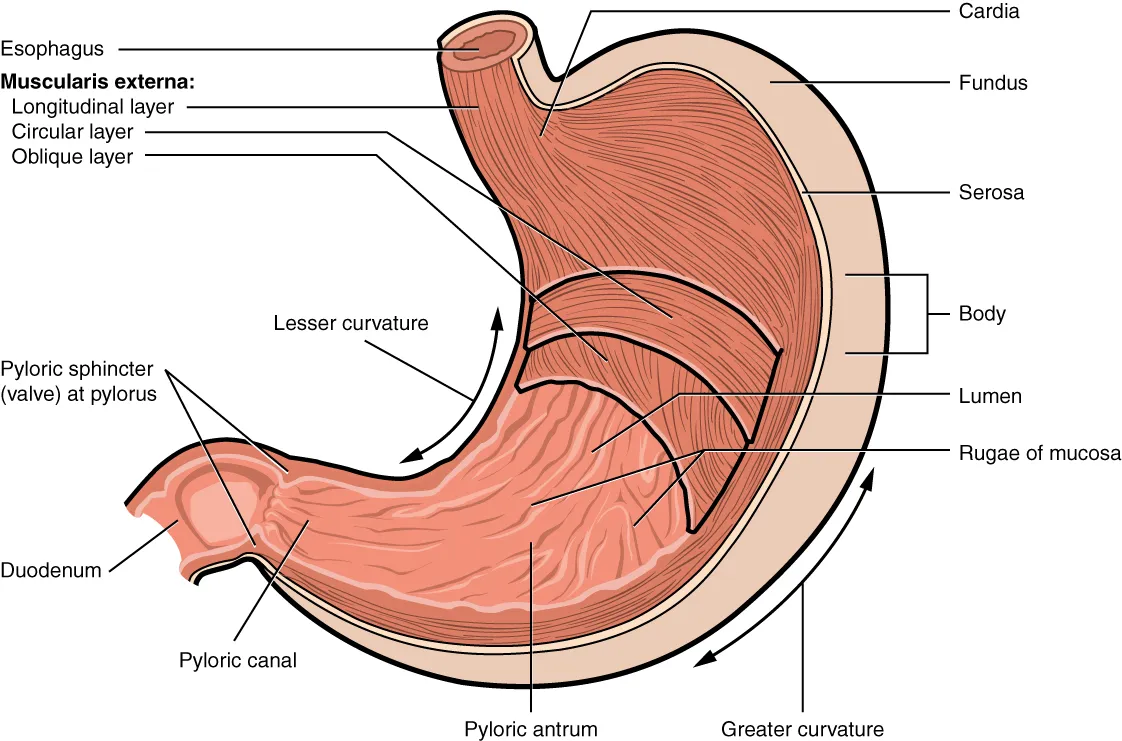
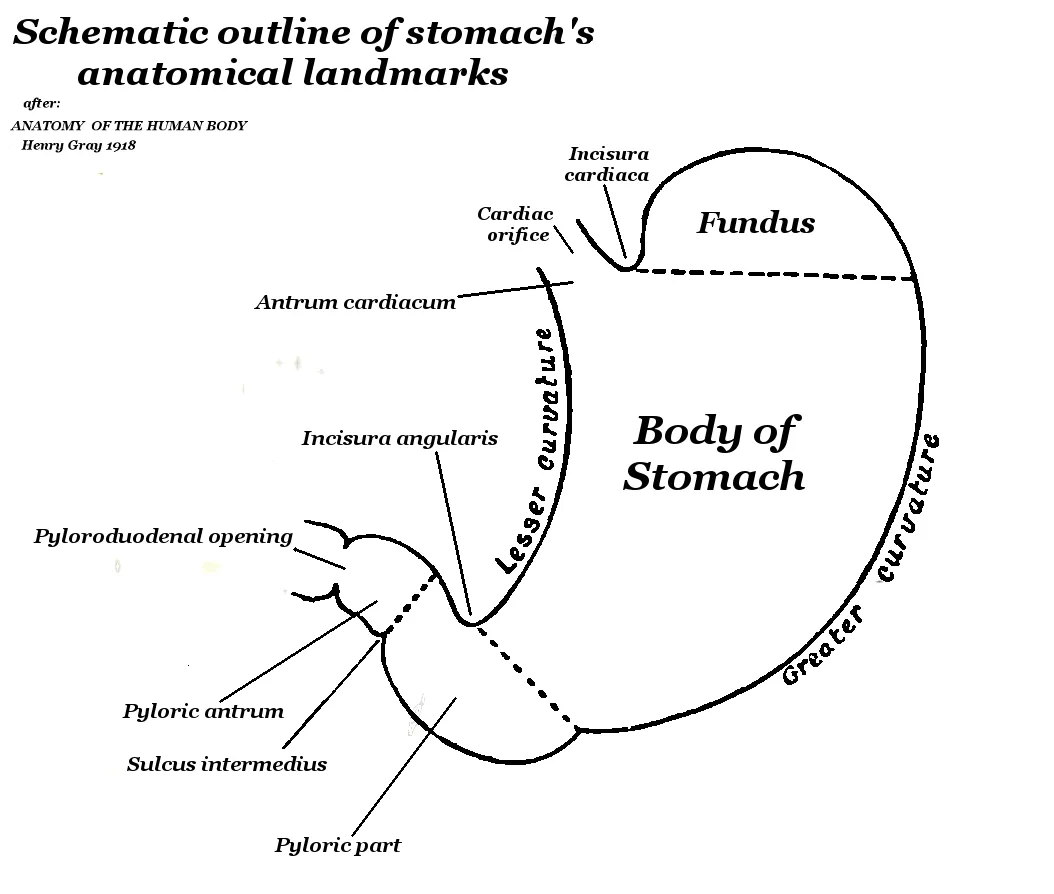
The region round the cardiac orifice where the oesophagus enters, at T11 behind the left seventh costal cartilage. The acute angle of His between the oesophagus and fundus, with its mucosal fold, forms a valve-like anti-reflux mechanism.
- 02
Fundus
Fundus gastricus
The dome above the level of the cardia, against the left hemidiaphragm, usually holding the gas bubble seen on erect films. Its wall carries gastric glands with parietal cells secreting HCl and intrinsic factor and chief cells secreting pepsinogen.
- 03
Body
Corpus gastricum
The largest part, from the fundus to the angular incisure of the lesser curvature; its mucosa forms longitudinal folds (rugae), and along the lesser curvature parallel folds form the “gastric canal”. Its glands, like those of the fundus, are the main acid-secreting zone.
- 04
Pyloric antrum and canal
Pars pylorica; Antrum pyloricum
The distal part beyond the angular incisure, narrowing into the pyloric canal. Its pyloric glands secrete mucus and its G cells gastrin; the antrum churns and propels chyme. The lesser curvature here is a common site of gastric ulcer.
- 05
Pylorus
Pylorus; Musculus sphincter pyloricus
A thickened ring of circular muscle round the pyloric orifice at L1 (the transpyloric plane), regulating the passage of chyme into the duodenum. The prepyloric vein (of Mayo) helps identify it at surgery; hypertrophic pyloric stenosis in infants a few weeks old causes projectile vomiting.
- 06
Curvatures and omenta
Curvatura minor et major; Omentum minus et majus
The lesser curvature gives attachment to the lesser omentum (to the liver) and carries the right and left gastric arterial arcade; the greater curvature gives attachment to the greater omentum and gastrosplenic ligament and carries the gastro-omental arcade. The greater omentum hangs like an apron over the intestines, holding fat and nodes, and moves to wall off inflammation.
- 07
Gastric mucosa
Tunica mucosa gastris
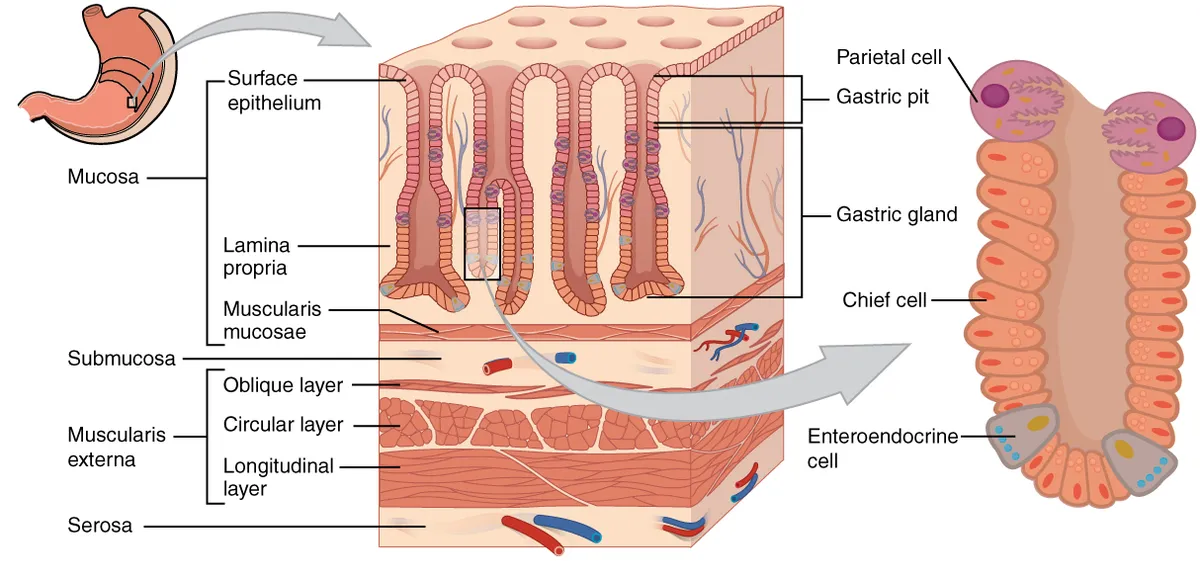
A simple columnar mucus-secreting epithelium dipping into gastric pits, each receiving 3–7 glands. A mucus–bicarbonate layer protects it from acid at pH 1–2; Helicobacter pylori and NSAIDs weaken this barrier and cause ulcers.
- 08
Muscular coat
Tunica muscularis gastris
The stomach is the only segment with three smooth-muscle layers: inner oblique, middle circular (thickened as the pyloric sphincter) and outer longitudinal. The myenteric plexus between them drives peristaltic waves about three times a minute from a pacemaker zone in the body.
- 09
Submucosa and serosa
Tunica serosa; Tela submucosa
The submucosa is loose connective tissue carrying the vascular and lymphatic plexuses and Meissner’s plexus. The serosa is the outermost visceral peritoneum, continuous with the two omenta at the curvatures.
Position and relations
The stomach lies in the upper abdomen, mostly under the left dome of the diaphragm, in the epigastric and left hypochondriac regions. It joins the oesophagus at the cardia (T11) and the duodenum at the pylorus (L1). Its anterior surface relates to the liver, diaphragm and abdominal wall; posteriorly, across the omental bursa, it relates to the pancreas, spleen, left kidney and suprarenal gland.
Form and structure
The stomach consists of the cardia, fundus, body and pyloric part, with lesser and greater curvatures. Its wall has four layers (mucosa, submucosa, muscularis, serosa); the muscularis has an extra innermost oblique layer that churns food. Fundic glands contain parietal cells, which secrete HCl and intrinsic factor, and chief cells, which secrete pepsinogen.
Vessels and nerves
The stomach has a rich supply from branches of the coeliac trunk: the left and right gastric arteries along the lesser curvature, the right and left gastro-omental arteries along the greater curvature, and the short gastric arteries to the fundus. The vagus nerves (parasympathetic) stimulate acid secretion and motility.
Acid secretion and mucosal defence
Parietal cells of the corpus and fundus secrete hydrochloric acid for digestion, mineral absorption and bacterial control. The H⁺/K⁺-ATPase exchanges cytoplasmic H⁺ for extracellular K⁺, and the secreted H⁺ combines with luminal Cl⁻ to form HCl. Secretion is tightly regulated by the vagus, gastrin, histamine, ghrelin, somatostatin, GLP-1 and others, so that digestion proceeds without injuring the gastroduodenal mucosa.[1]
The stomach withstands concentrated acid, refluxed bile salts, alcohol and food of widely varying temperature and osmolarity thanks to protective mucosal responses and rapid repair. Prostaglandins modulate virtually every aspect of this defence, which is why non-steroidal anti-inflammatory drugs, by blocking prostaglandin synthesis, predispose to ulceration.[2]
The pylorus controls flow between a reservoir for mechanical and chemical digestion (the stomach) and a conduit for absorption (the intestine). Unlike most gut sphincters, the human pylorus is patent most of the time: isotonic fluids pass while particles too large are retained and processed further by the antrum (gastric sieving); only intermittently does it close tightly by contracting its proximal and distal muscle loops.[3]
Clinical correlations
The corpus mucosa responds to injury by depth: superficial injury heals via surface cells, while deep, chronic injury (usually Helicobacter pylori) causes pyloric metaplasia, with loss of parietal cells (atrophic gastritis) and reprogramming of chief cells into mucous cells, a step on the road to cancer.[4]
Autoimmune gastritis destroys parietal cells of the corpus and fundus, causing vitamin B12 deficiency and pernicious anaemia; because acid is also needed for inorganic iron absorption, iron deficiency (often in young women, refractory to oral iron) usually comes first. Gastroparesis is gastric retention without obstruction, linked to abnormalities of enteric neurons, smooth muscle and interstitial cells.[5][6]
The stomach of a term newborn holds about 20 ml at birth, which corresponds to a feeding interval of roughly one hour, matching gastric emptying of human milk and the neonatal sleep cycle.[7]
Full-text reading (StatPearls)
The StatPearls chapters on this topic, reproduced verbatim. Their CC BY-NC-ND 4.0 licence allows unmodified copies only, so they are not translated or shortened.
Anatomy, Abdomen and Pelvis: StomachChaudhry SR, Liman MNP, Omole AE, Peterson DC · StatPearls 2024 · NBK482334 · 14k characters
Loading…
Chaudhry SR, Liman MNP, Omole AE, Peterson DC. Anatomy, Abdomen and Pelvis: Stomach. StatPearls [Internet]. Treasure Island (FL): StatPearls Publishing; 2024. NBK482334 · PMID 29493959 · CC BY-NC-ND 4.0. Reproduced verbatim, unmodified.
Anatomy, Abdomen and Pelvis: Stomach Gastroepiploic ArteryO'Malley J, Bordoni B · StatPearls 2022 · NBK545306 · 10k characters
Loading…
O'Malley J, Bordoni B. Anatomy, Abdomen and Pelvis: Stomach Gastroepiploic Artery. StatPearls [Internet]. Treasure Island (FL): StatPearls Publishing; 2022. NBK545306 · PMID 31424890 · CC BY-NC-ND 4.0. Reproduced verbatim, unmodified.
Organs in this system
References
Sources for the values and descriptions on this page, indexed in PubMed (US National Library of Medicine).
- [1]The Physiology of the Gastric Parietal CellEngevik AC et al., Physiological reviews 2020PMID 31670611
- [2]Prostaglandins, NSAIDs, and gastric mucosal protection: why doesn't the stomach digest itself?Wallace JL, Physiological reviews 2008PMID 18923189
- [3]The pylorusRamkumar D et al., Neurogastroenterology and motility 2005PMID 15836452
- [4]Cellular Plasticity, Reprogramming, and Regeneration: Metaplasia in the Stomach and BeyondGoldenring JR et al., Gastroenterology 2022PMID 34728185
- [5]Autoimmune gastritisKulnigg-Dabsch S, Wiener medizinische Wochenschrift 2016PMID 27671008
- [6]GastroparesisHasler WL, Current opinion in gastroenterology 2012PMID 23041675
- [7]Neonatal stomach volume and physiology suggest feeding at 1-h intervalsBergman NJ, Acta paediatrica 2013PMID 23662739
- [8]Gastrointestinal mean transit times in young and middle-aged healthy subjectsPMID 11318834Supports: Gastrointestinal transit time
- [9]Revised Estimates for the Number of Human and Bacteria Cells in the BodySender R, Fuchs S, Milo R, 2016PMID 27541692Supports: Colonic bacterial count